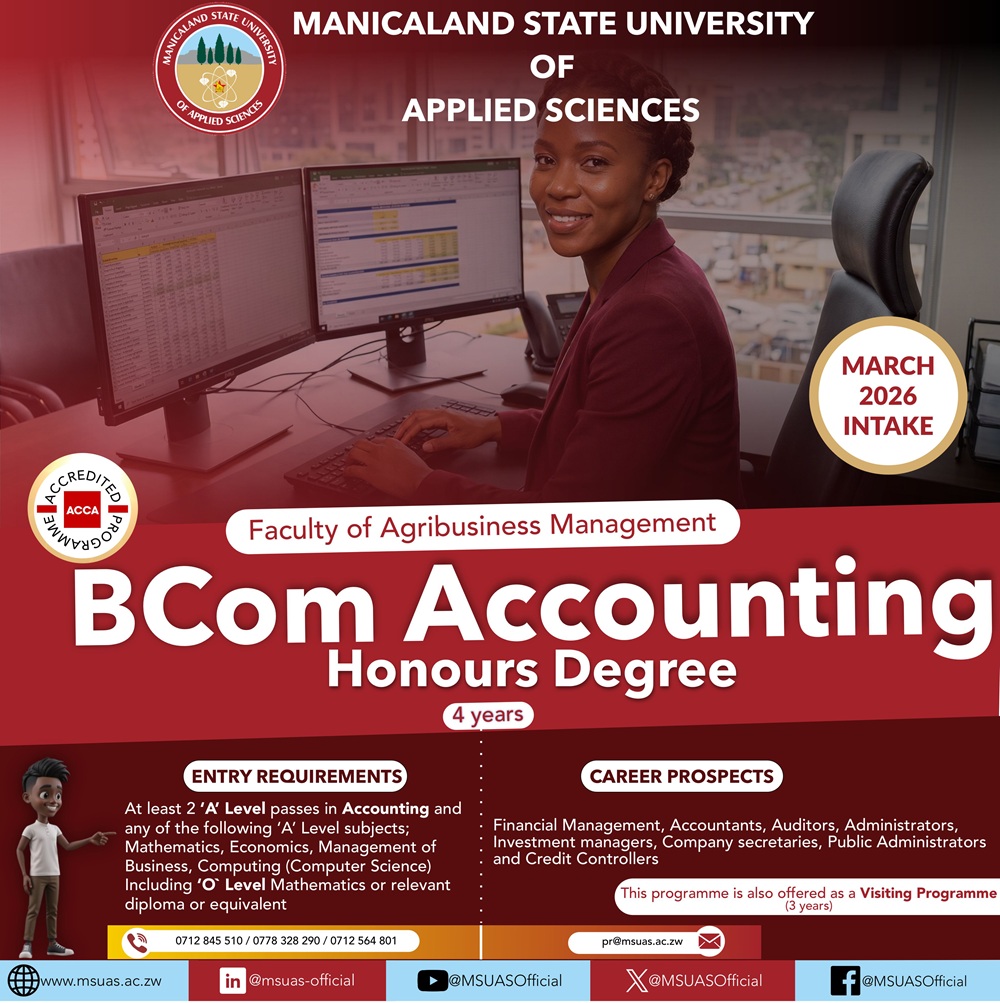

Welcome to the Department of Applied Accounting Sciences at Manicaland State University of Applied Sciences. The department takes pride in being founded in the year 2018, years after most universities established their accounting departments. In designing its program structure, the department has borrowed from its predecessor universities as well as professional bodies hence coming up with a program that creates jobs and provides industry with solutions to its problems in a dynamic economic environment.
To qualify for entry into the Bachelor of Accountancy Honours Degree programme, a candidate, in addition to satisfying the minimum conditions as prescribed under the General Regulations for English and Mathematics at “O” Level must have obtained a pass in “A “Level Accounting and any of the following “A” Level subjects:
Mathematics; Economics; Management of Business, Computer Studies.
1. Candidates who have successfully completed a Professional Accounting Diploma or have obtained equivalent qualifications within three years may apply for direct entry into Level 2 of the degree programme, subject to availability of places.
2. Candidates admitted under regulation 8.3.1 above will be exempted on a module by module basis.
3. Students who would have been admitted under 8.3.1. will be exempted on a module by module basis after their applications for exemptions are successfully considered.
4. No candidate may normally complete the degree in less than three academic levels.
5. Successful completion of Work-Related Learning component at level three is compulsory for all candidates.
Persons who are at least 25 years of age for males and 23 years for females on the first day of the academic year in which admission is sought and who are not eligible for entry under the Normal entry regulations may apply for Mature Entry provided that:
1. Applicants must have passed at least five approved ‘O’ Level subjects including English language and Mathematics and must have demonstrated potential suitability for University studies by virtue of their attainments and or work experience
2.Normally, applicants should have completed their full-time school or college education at least five years before the start of the academic year in which admission
is sought.
3. Applicants who wish to be considered under Mature Entry provision may be required to attend interviews and or special tests at the university designed to assess their command of the English Language, numeracy, reasoning ability and general
suitability for the Bachelor of Commerce degree studies.
4.Applicants who have previously attended Mature Entry tests and or interviews without success will not be considered for admissions under this form of entry unless in the intervening period they have acquired additional qualifications or experience.
To qualify for entry into the Bachelor of Accountancy Honours Degree (Visiting School) programme, a candidate, in addition to satisfying the minimum conditions prescribed under the General Regulations must have:
EITHER:
A National Diploma (complete qualification) in Accounting, Business Studies, Public Sector Accounting, Diploma in Education or any equivalent tertiary qualification
OR:
At least two (2) passes in relevant “A” Level subjects
AND:
Proof of employment. Where the prospective student is not formally employed the department will interview the student to assess suitability for enrolment under the visiting school programme.
The purpose of the programme is to produce technically focused and well-rounded graduates with a comprehensive knowledge base for identifying, analyzing, evaluating and solving problems in core areas of financial accounting, auditing, taxation and financial management. Students should be able to reflect on their decisions and applications in these fields to assess the effect thereof in the holistic context of accounting as a practice and demonstrate initiative and responsibility, and that shall enable the development of leadership qualities.
The Bachelor of Accountancy Honours Degree is a very competitive degree programme. Graduates can be employed as;
• Auditor
• Chartered accountant
• Chartered certified accountant
• Chartered management accountant
• Chartered public finance accountant
• Certified Financial Analyst
• Company secretary
• Forensic accountant
• Stockbroker
• Tax adviser/ officer
• Accounting Lecturer
Masters In Applied Accounting
Msc Accounting and Finance
Masters in Business Management
Chartered Institute of Management Accountants. (CIMA).
Certified Public Accountant. (CPA)
Chartered Certified Accountant (CCA)
Association of Chartered Certified Accountants (ACCA)
The module is designed for those students with “A” Level Accounting. The module focuses on principles and techniques of Financial Accounting and their application to the preparation of financial statements culminating in analysis and interpretation of financial data.
The module builds on the foundation laid in Financial Accounting IA. The module aims at
developing a thorough understanding of the practical framework of Accounting and an ability to prepare, analyse and interpret financial statements. It module covers all the latest developments of International Financial Reporting Standards (IFRS) applications in
relationship to the areas covered.
The module introduces students to the role of computers in the business world and builds on
the uses of different application packages in their field of study. It covers the following: basic fundamental concepts, management’s need for information and types of systems, transaction processing as well as an industry specific project.
The module introduces students to the basic legal principles governing the business environment. Focus shall be placed on definition of contracts, requirements of a contract, breach of a contract, remedies for breach of contracts, law of agency, contract of sale, law of business organisations and insurance contract.
This module will study markets and the decision making embedded therein. It will discuss standard economic arguments that free markets work “best”, the conditions under which thesearguments are most believable, and policy options when these conditions are not met. The module will examine both competitive markets, for which basic models of supply and demand are most appropriate, and markets in which agents act strategically, for which game theory is the more ppropriate tool. The module will cover, inter alia, economic theory and the market economy, consumer theory, choice under uncertainty, production and costs, efficiency and trade, market equilibrium, game theory and imperfect competition.
The module introduces students to the mathematical tools relevant for application to the business environment. Students shall be expected to recognize the value of quantitative
methods in analysing data and interpreting it in order to make relevant business decisions.
The module is designed to address how economists model the relationships between aggregate economic variables and examine how various fiscal and monetary policies can affect the results. The main goal is to improve students’ economic literacy and ability to apply economic models to analyse real world events. This module will be taught from an equilibrium perspective. This means the module will work with economic agents that optimize and with aggregate consistency conditions. Along with building basic economics intuition, the module will be centered on constructing and understanding macroeconomic models. These models will be used to discuss the theory of long-run economic growth and short-run economic fluctuations and to analyse macroeconomic policy, in particular fiscal policy.
This module introduces learners to the fundamentals of communication skills in an academic setting – speaking, listening, reading and writing. These include style and appropriateness, formal and informal styles of writing, organisation of writing, paragraphing, developing an argument, referencing and editing
The module deals with definition of management, types of organisations, history and development of management thought, functions of management, levels of management and skills, managerial roles, delegation of authority, decentralization, decision making, Management By Objectives (MBO), motivation and its theories, Planning, types of planning, strategic planning, planning process, barriers to effective planning. The module covers organizing, principles of organizational design, organizational structure departmentalization, delegation, line and staff functions, span of control, directing (leadership) function, types of
leadership, approaches to leadership style, contemporary leadership models, Motivation,application of motivation theories in workplace, controlling, budgetary and non-budgetary controls, change management, theories of change, organizational development, globalization.
Principles of Marketing introduce students to be key marketing concepts that they will cover in-depth in subsequent specialized marketing modules. It will familiarize students with marketing mix elements (product, pricing, promotion and distribution) enhance student’s
environmental analysis techniques and introduce them to strategy formulation
The module is intended to enable the students to acquire knowledge about the significance of
computers in a business environment. The main thrust of the module will be the practical use
of spreadsheet software in an accounting environment and the use of computerized accounting software packages to generate financial reports. Students will also learn the application of general accounting principles when processing data using accounting software packages.
The objective of the module is to expose students to concepts and theories of business
communication and to assist them to develop into good and competent communicators. It
focuses on the development of student’s ability to communicate effectively and concisely in
written, oral and any other forms of communication. It also considers different styles in the use of English in business settings, communication skills, letter writing, business reports, note taking, meetings, minutes, summarizing and referencing.
The module will look at business development, barriers encountered and issues related to marketing, human resources management, pricing, government policies, and taxation of businesses. Case studies, visits to business premises and presentations by entrepreneurs will be used to understand the running of business. The preparation of business plans will also be
covered.
In this module the students will become acquitted with sample research methodologies such as survey and field research, questionnaire design, content analysis, analysis of existing data,individual and group observation e.t.c. The module will also introduce students to the
safeguards against errors in both data collection and data analysis and reporting. In addition,
the module will draw the attention of students to an important but often neglected aspect of
social research i.e. the ethical issues in social research, covering topics such as voluntary
participation, anonymity, confidentiality and the need to adhere to professional code of ethics.
Practical experience from studies in other countries will be used to expose the student to
practical issues in research. The student will also be introduced to the basics of analysing
research data. The module offers an overview of different approaches, considerations and
challenges involved in social research.
This module is intended to enable students to; understand and appreciate the behavioural andmanagement science evolution, appreciate that the organization itself is a mega system
composed of various other sub-systems, analyse individual behavior, underscore the need for human motivation and leadership; understand the meaning of organizational culture and how it influences the way employees behave in the organization.
The module builds on the foundation laid in Financial Accounting IA and 1B. The module aims at providing students with knowledge of Accounting as related to accounting for specialized transactions, interpretation of financial statements, published accounts etc.
A continuation of Financial Accounting IIA. The module aims at helping students develop a
thorough understanding of the practical framework of accounting and imbibe an ability to apply the International Financial Reporting Standards (IFRS), Financial Reporting Standards as adopted by the Institute of Chartered Accountants of Zimbabwe and PAAB.
The module is meant to provide an understanding of the nature, purpose and scope of Auditing, principles of Auditing and application of ISA. It also addresses the role of the external audit, planning, current issues in Auditing and its regulatory framework.
The module focuses on the performing of the audit process and its application in the context of the regulatory framework and for business control and development.
The module aims at providing an understanding of the principles, concepts and techniques of Management and Cost Accounting and helps students develop an ability to apply this knowledge to practical situations related to cost ascertainment, cost control and planning.
The module is intended to equip the student with the relevant principles and knowledge on how organisations are run, paying particular attention to best practices and ethical behavior. Areas covered included principles of corporate governance, white color crimes, and whistle blowing and industrial espionage, principles of business ethics in international context, environmental ethics, and industrial relations ethics. Students credited with this module are equipped with the skills to identify and evaluate the efficiency of internal controls in different business cycles and to report thereon to the management of an ordinary company trading in goods and services.
The aim of the module is to identify the objective that Corporate Finance managers pursue or ought to pursue in order to satisfy the needs of corporate stakeholders and to develop, in students, concepts and corporate analytical tools that shall enable them to meet this objective. To this end, the module shall cover the following critical areas: Goals of a firm and the agency theory; Time value concepts and valuation of bonds and shares; Capital Budgeting under certainty; Operating and financial leverage; Introduction to portfolio theory and capital asset pricing; the stock market and other sources of long-term capital; innovations in Corporate
Finance.
To provide knowledge and understanding of the nature and basic principles of law related to Limited Liability Companies, Partnerships, Company Secretarial Practice, Meetings and
Elements of Labour Law and Labour relations
The module is intended to provide the student with an overview of the Zimbabwean tax system. On completion of this module students will have a detailed knowledge of the Zimbabwean Tax Law as provided through the Income Tax Act. The module is intended to enable the student to
calculate the taxable income and liability for individuals, business, farmers and miners. The main areas to be covered include tax avoidance and evasion, estate planning, mechanisms and
implications of the Value Added Tax Act, Capital Gains Act and the Estate Duty Act.
The module is a build-up on Tax law and Practice 1. The module is intended to equip students with relevant knowledge on the Zimbabwe Tax law and its administration with a strong emphasis on real life tax planning issues, which is the application of taxation knowledge for the best advantage of business and individuals. The module seeks to provide students with an understanding of the principles and practices of secretaryship relating to tax issues, income and corporate tax compliance procedures, utilization of income and corporate tax registration and reporting forms, the income and corporate tax cycle.
The module aims at equipping students on financial literacy in the digital age. Aspects of the curriculum will cover topics like, Goal of digital financial services, Mobile financial services, agent banking, digitalservice providers, digital financial products and services, digital financial services ecosystem, evolution of digital financial services ecosystem, digital financial models, digital financial services role in financial inclusion, issues and challenges of digital financial services in the ecosystem, legal and regulatory framework for digital financial services. Financial Technologies like cloud computing, e-gaming, crowd funding systems, mobile payment systems, distributed ledger technology etc.
Approved work related learning of not less than eight (8) months and not more than twelve (12) months is aimed at providing third year students with a practical exposure to the professional practice of accounting and business environment. The candidate is expected to rotate the various accounting related departments of the organization to which he/she will be attached to enable them to be exposed to all functions of that organisation. The candidate must be appraised by the departmental supervisor who assigns the student day to day duties and a percentage score should be given before leaving for the next department. The student is also assessed by an academic supervisor
The module is a problem-based report developed by the candidate during internship. The thrust of the report is to relate theory covered in the university to practice. It follows a schematic report layout covering issues such as, company background, departments attached, challenges
encountered, new issues learnt, any gap between information covered in the University, review of related literature to issues covered, comparison of practical issues and reviewed literature, any gap and conclusions and recommendations to the company and the University. A guideline
to the development of the report is issued to the candidates as a module outline.
The module focuses on Accounting Theory and current issues relating to financial reporting. It
concentrates on the role of Accounting Theory, users and objectives of corporate reports,
Accounting for price level changes, analysis and interpretation of financial statements, cash
flow statements and application of International Financial Reporting Standards (IFRS).
The module seeks to consolidate the developments, installation and management of
Information Systems. It emphasizes on the understanding of Information Technology and
information systems concepts with regard to planning, organizing, controlling and decision
making of an organisation as well as use of information technology tools.
The module is a continuation of the Management and Cost Accounting at Part II level and seeks
to consolidate students’ knowledge and understanding in behavioural aspects of Management and Cost Accounting, covering Management & Cost Accounting, Budgetary Control, Standard Costing and current issues in Management Accounting.
The module is a continuation of the Financial Reporting and Financial Accounting II modules.
It aims at students having a thorough knowledge of Advanced Accounting principles and
practices as they apply to the rapidly changing international business environment. It focuses
on group financial statements, accounting for foreign currency transactions, valuation of
businesses, re-organisations, mergers and takeovers and deferred taxation and relevant
International Financial Reporting Standards (IFRS).
The module is a continuation of the Part II Auditing modules. The module seeks to provide a comprehensive knowledge of the financial reporting provisions of the Companies and Other
Business Entities Act and focuses on Auditing issues and disclosure aspects of Financial
Statements and specialized Audits and Investigations. It also covers Computer Auditing and auditing in a computerized information system environment.
The module focuses on the principles, concept and techniques used in making financial
management decisions. It aims at ensuring that the students understand the concepts and
applications behind theoretical models, select the techniques most appropriate to optimize the employment of resources, treasury management function, working capital etc.
The module is a continuation of the Management and Cost Accounting II and discusses the
characteristics of strategic Management Accounting decision including performance
evaluation, control quantitative techniques, TQM, ABC and non-financial performance
measures.
The module aims to equip students with knowledge of public sector accounting. In particular, the preparation of annual financial statements in compliance with International Public Sector Financial Reporting Standards (IPSAS). The module aims to equip students on similarities and differences between the public sector and private sector accounting and reporting.
This module guides and tests the student’s ability to actualize the theoretical problem-solving skills acquired in earlier research methods modules such as Research Methods and Data Analysis. Students will be expected to competently tackle all the stages of a dissertation starting from formulating research proposals, that is, review of literature, identifying research problems,
formulating a research design, design of data collection instruments, data collection, data
cleaning, data analysis, interpretation and presentation. Students will be provided with the written departmental guidelines on writing dissertations.
The module is aimed at equipping students with knowledge of sources of funding of public utility
entities, skills and competencies of managing public financial resources, including understanding of factors influencing investment decisions and legal requirements. It covers the theoretical substructures and institutions that deal with the country’s public financial management. Students will also gain understanding of special funds created by municipal accounting as well as be able to prepare financial statements of public utility entities.
The module aims to equip students on similarities and differences between the public sector and private sector organisations. The focus will be particularly on issues surrounding budgeting, accounting, auditing and general accountability. Students will appreciate the accounting frameworks used by public utility entities, thus local authorities and central government bodies, and be able to discuss the differences between them.
The module seeks to provide students with an understanding of the principles and practices of
secretaryship relating to tax issues, income and corporate tax compliance procedures, utilization
of income and corporate tax registration and reporting forms, the income and corporate tax cycle.
The module seeks to equip students with tax audit techniques and skills and be able to plan and carry out tax audits effectively. In particular, to equip students with the basic concepts of
stewardship accounting, the theory of audit and the revenue audit cycle. This will also include
aggressive planning.
The module is intended to provide knowledge and skills needed to advise and guide management on risk management structures and processes. Understand contrasting approaches; gain the skills to critically evaluate organizational structures and processes; build skills in communicating advice and assistance to management in the maintenance of corporate governance and risk management frameworks and activity. Understanding the structured approach to ERM and the requirements of ISO31000
The module is intended to equip students with knowledge about the internal audit environment.
Students should understand the structural, cultural and political framework of an organization and equip themselves to deliver effective assurance and consultancy services within that environment. Includes managing the impact of change, performance management and the influence of different leadership and management styles
Loading