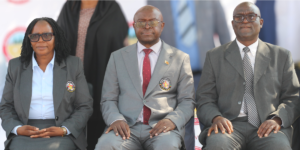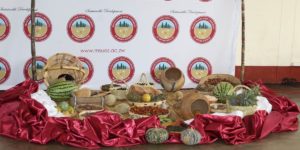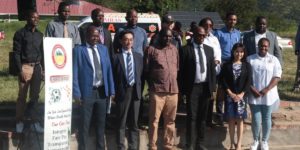
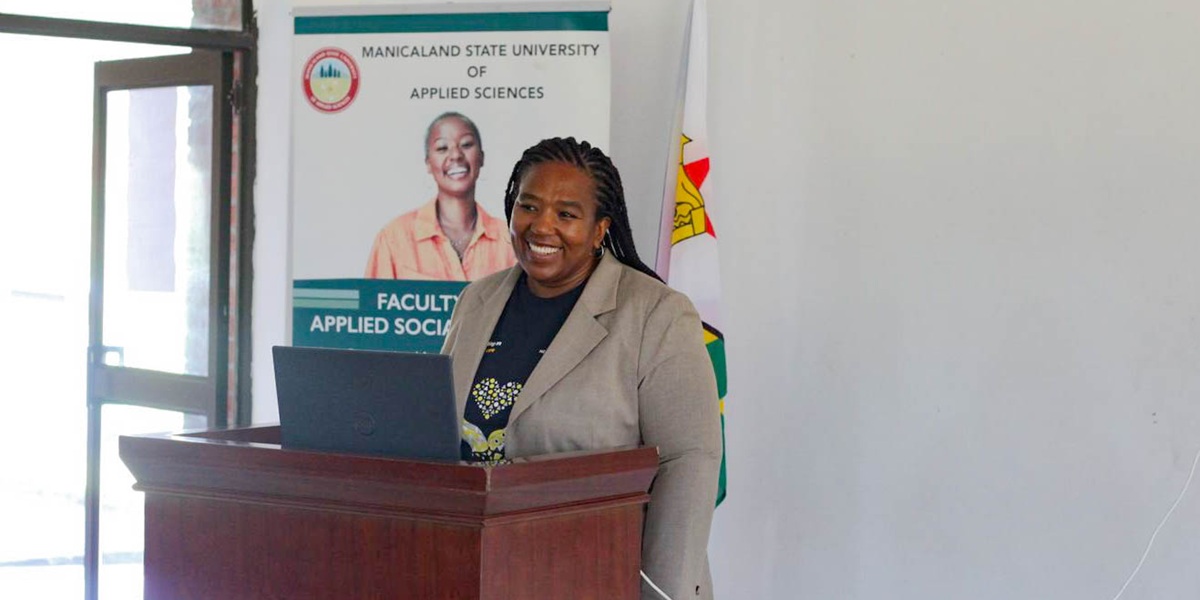
As part of its 10-year anniversary celebrations, Manicaland State University of Applied Sciences (MSUAS) hosted a thought-provoking public lecture on Thursday at its Fernhill Campus in Mutare.
The lecture featured Dr Buyiswa Hlangothi, a Senior Lecturer in Organic Chemistry at Nelson Mandela University, who led an engaging discussion on the intersection of modern science and African medicinal knowledge systems.
In his opening remarks, MSUAS Vice Chancellor Professor Albert Chawanda reaffirmed the University’s commitment to advancing research that supports national development while preserving Africa’s rich indigenous knowledge systems.
He emphasized that MSUAS continues to prioritise innovation anchored in ethics, in line with the principles of Education 5.0.
“MSUAS is dedicated to producing graduates and research outputs that contribute to the sustainable utilisation of our natural resources while preserving the integrity of indigenous knowledge systems,” said Professor Chawanda.
He also highlighted the importance of public lectures in fostering intellectual engagement, broadening perspectives, and bridging the gap between academia and real-world challenges.
Presenting under the topic “Is Modern Science an Enabler for the Exploitation of African Medicinal Plants?”, Dr Hlangothi unpacked the complex relationship between scientific advancement and the preservation of indigenous knowledge.
She noted that while modern science has played a crucial role in validating the medicinal properties of African plants, it also raises concerns around exploitation and the commercialisation of these resources without fair recognition and benefit-sharing for local communities.
“Modern science has the capacity to unlock immense value from African biodiversity, but it must be guided by ethical considerations that protect indigenous knowledge holders,” she said.
Dr Hlangothi called for a balanced approach that promotes innovation while safeguarding cultural heritage. She urged researchers, academics, and students to adopt ethical research practices and ensure that the utilisation of natural resources meaningfully benefits the communities from which such knowledge originates.
The lecture sparked vibrant discussions among MSUAS students, staff, and stakeholders, who expressed a renewed appreciation of the role of science in society and the responsibility that comes with it. Participants also explored how scientific research can drive sustainable development while upholding ethical standards.
By enriching academic dialogue, the public lecture reaffirmed MSUAS’s commitment to producing graduates who are innovative, ethically grounded, and equipped to contribute to national and continental development.