
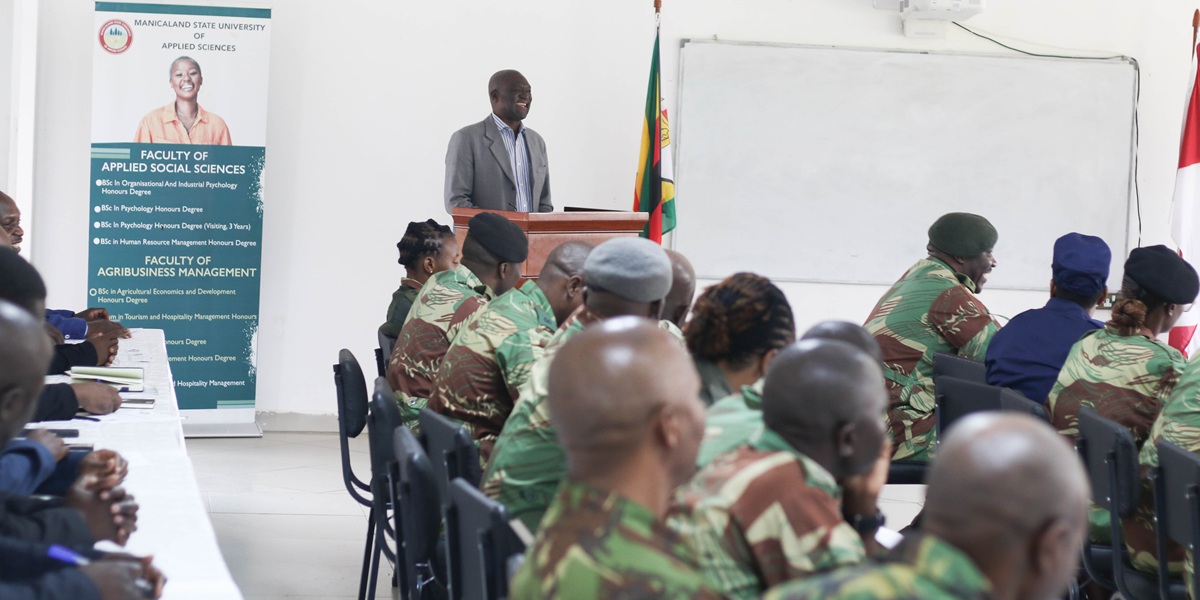
Manicaland State University of Applied Sciences (MSUAS) hosted a high-level delegation from the Zimbabwe Staff College (ZSC) at its Fernhill Campus in Mutare on 18 2026, to deliberate on the critical intersection of academic innovation and national stability.
The visit, which was held under the theme “Economic Resilience for National Security,” brought together military strategists and academic leaders to explore how higher education drives industrial development.
The delegation sought to understand the practical contributions of MSUAS to the nation’s primary and secondary industries, particularly through the lens of Education 5.0.
In his welcome remarks, MSUAS Vice-Chancellor Professor Albert Chawanda emphasised the growing convergence between higher education and national leadership.
He emphasised that MSUAS is strategically positioned to drive Zimbabwe’s development through applied science and technology, challenging both institutions to collaborate in shaping the nation’s growth.
“Your presence here today reflects not just a courtesy visit, but the strategic convergence between higher education and national leadership.
“Together, let us shape a future where knowledge drives strategy and innovation underpin national development,” said Professor Chawanda.
Executive Dean of Research, Innovation, and Postgraduate Studies, Dr Crispen Bhukuvhani provided a historical perspective on the institution’s rapid growth, highlighting that MSUAS was established in 2016 after being successfully incubated by Midlands State University.
“The primary objective of a university is not only to teach but to create knowledge and apply it in ways that meaningfully serve the community.
“MSUAS supports the mining sector and national security by producing specialised personnel in engineering and cybersecurity, while leveraging its Innovation and Agro-Industrial Park to strengthen food stability,” said Dr Bhukuvhani.
The engagement highlights MSUAS’s tangible contributions to food security, as it prepares 60 hectares for winter wheat production and expands its beef cattle herd through its Agro-Industrial Park, reinforcing that national security is rooted in economic self-sufficiency.
The exchange concluded with both parties committing to establish a Memorandum of Understanding (MoU) between the ZSC and MSUAS, aiming to advance joint research and community engagement while ensuring academic output remains a cornerstone of national progress and security.
MSUAS already has an existing MoU with the Zimbabwe Prisons and Correctional Service (ZPCS), which focuses on collaborative initiatives in inmate rehabilitation, skills development, and reintegration support.
ZSC visitors ended their tour of MSUAS with an exciting walkthrough of the campus, including a firsthand glimpse of the hostels under construction.